

How Triangle Equine Assisted Learning is helping people build confidence, connection, and self-awareness
Some of the most meaningful work happening in this community right now has nothing to do with real estate. It has everything to do with what people are carrying when they walk through the door of a new home — or any door, for that matter.
Devon Broughton spent years on my team. She is one of the most perceptive people I have worked alongside in this business. She is also someone who, if you know her at all, you know about her love of horses. She knows horses the way most people know the people they're closest to — their personalities, their moods, what they need and when.
So when she told me she was stepping back to build something rooted in horses and personal development, I wasn't surprised. I was interested.
What she built is Triangle Equine Assisted Learning (Triangle EAL), based in Wendell, NC.
What Equine Assisted Learning Is
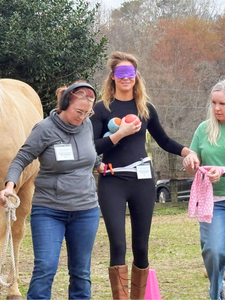
Participants work through a ground-based equine assisted learning exercise with horses.
People learn early how to mask what they're feeling. We read a room, adjust, perform confidence we don't always have. It makes honest feedback rare — and self-awareness even rarer.
Here's what I've learned from Devon: horses don't do that. When you bring tension, uncertainty, or disconnection into the arena, the horse responds to it — not with words, but with action or deliberate inaction. They move toward you or they don't. They follow your lead or they won't. That response, immediate and unfiltered, is the information. And it's harder to dismiss than anything a person could tell you.
Equine Assisted Learning is a peer-reviewed, curriculum-based approach to personal and professional development built around exactly that dynamic. Triangle EAL is one of a growing number of organizations using this methodology to help individuals and teams develop confidence, communication, and self-awareness — but Devon's approach has a specificity and structure that sets it apart.
Participants work through structured exercises in the arena alongside horses — no riding involved — while a certified facilitator guides the experience. The horses respond in real time to what participants bring into the space. Body language. Energy. Confidence. Avoidance. The horse reads all of it.
Devon explains the biology behind it: "Horses are prey animals. Their eyes are on the sides of their heads. Ours are in front of ours — we are predators, and they know it instantly. Their survival has always depended on reading the world around them accurately. They have been on this earth for over 55 million years. They know something we don't know about survival — and a lot about what we, as potential predators, are projecting through our body language."
When a horse won't approach you, or won't follow your lead, they aren't being stubborn or unfriendly. They're giving you information. And that information, surfaced in real time without judgment, becomes the starting point for real change.
The Woman Behind Triangle EAL
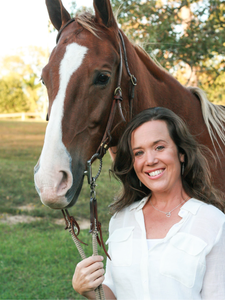
Devon Broughton, founder of Triangle Equine Assisted Learning, with one of the horses central to her work.
Devon has been working with horses since she was eight years old. She competed at the world championship level, finishing second in the world three times in Kentucky across multiple divisions. Horses have been a constant — through the best parts of her life and the hardest ones.
She always wanted to build a career around them. When equine assisted learning was just beginning to emerge as a field, Devon was in high school, watching it take shape and thinking it was too new, too unproven to build a life around. So she went into real estate instead — and spent more than two decades building a successful career in it.
Then it came back around. She found a certification program. She enrolled, trained at Dreamwinds Equine Assisted Learning Center, and earned her certification in 2023. Triangle EAL launched to the public in early 2024.
It was not a career change so much as a return.
The Story That Sparked Helping Hooves, A Community Program
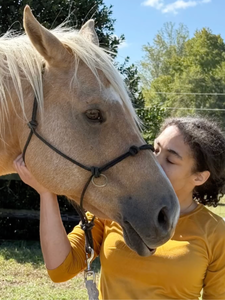
Jennifer during a Triangle Equine Assisted Learning session in Wendell, NC.
Triangle EAL cites that 60% of young adults live with loneliness and emotional disconnection. Jennifer is one of those people.
Jennifer moved to North Carolina from New York six years ago, during COVID. In her own words: "I was having a hard time trying to understand my emotions, processing grief, and just trying to have some confidence. I was anxious. I had a hard time trying to get through hard things. And I just couldn't really follow through. I was having a hard time connecting with others."
Her therapist recommended Triangle EAL. When Devon explained how the program worked — not therapy, but personal development with horses — Jennifer was drawn to it.
Devon noticed early on that Jennifer struggled with simple decisions. She apologized for things that didn't need apologizing for. She was late. She skipped sessions. She was falling behind in school. Her confidence was close to zero.
In her first session, the horses surfaced something specific: boundaries. Jennifer had none, and the horses made that visible immediately. Then something else happened. The horses started mirroring her back to herself. She was detached from her own feelings, and the animals reflected that detachment in a way no conversation had managed to.
Devon describes the mechanism simply: "Recognition creates awareness, and awareness leads to change. When a horse says 'I'm not doing this with you,' the participant gets the opportunity to change their approach. When they get it right, the horse rewards immediately. That is behavior modification happening in real time."
Jennifer experienced that change firsthand.
"The horses taught me boundaries," Jennifer says. "They helped me with connecting with other people and bonding with other people, because that was something I was always anxious about… I felt like I learned a new thing each time that I came here."
By the sixth session, she noticed the shift outside the arena. She was leaning into conversations instead of running from them. She was advocating for herself with family members. For the first time in a long time, she had a sense of self, and she was happy.
She told Devon: "This is my most favorite part of the week."
Today, Jennifer works at a mental health facility in Durham. She has come back to Triangle EAL for more sessions. And her story became the foundation for something bigger.
Building Helping Hooves
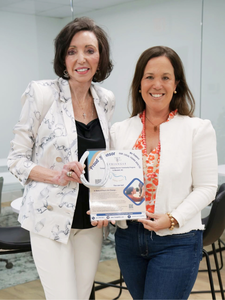
Devon Broughton, founder of Triangle Equine Assisted Learning, with one of the horses central to her work.
Jennifer inspired the Helping Hooves Community Program, a scholarship-funded community initiative through Triangle EAL that provides sessions at no cost to selected adults in the community who can't afford it.
In January, Devon discovered Horses for Mental Health, a global nonprofit that connects equine-assisted programs worldwide, backed by corporate sponsorships and a growing body of research. When Devon saw they were offering fiscal sponsorship partnerships for Mental Health Awareness Month (May 2026), she applied.
She was approved in February 2026 — one of 130 program partner organizations worldwide selected to participate in the campaign.
Devon assembled a volunteer task force committee. They held their first launch meeting in March. They ran EAL sessions as part of the committee's own development. They built their fundraising story, workshopped their pitch, and prepared to go out and raise money for a cohort of six young adults — ages 18 to 29 — to complete a 10-week program addressing chronic loneliness, social isolation, depression, and anxiety.
Their fundraising goal was $8,000. The campaign closed with $9,700 raised, supported by 10 corporate sponsors and 70 donors.
Marti Hampton Real Estate was the first corporate sponsor of the campaign. Chewy, the national pet retailer, also came on board as a corporate sponsor — a signal that what Devon is building is resonating well beyond this immediate community.
What Comes Next for Helping Hooves
The campaign wrapped at the end of May. Triangle EAL is now in Phase 2 of a four-phase process.
Phase 2 focuses on applications and outreach — building partnerships with mental health professionals and community organizations who can connect potential participants to the program. Devon and her team are also scheduled to have booths at upcoming local events to keep spreading the word and reaching potential applicants directly. Phase 3 is the 10-week program itself, with all six cohort members working alongside the horses. Phase 4 is a Celebration Banquet for program graduates and the corporate sponsors who made it possible.
It is a process meant to turn intention into action.
I have spent more than 40 years in this business watching what it takes for people to make clear decisions in high-stakes moments. The patterns are consistent. Confidence, self-awareness, the ability to read a room and trust your instincts — those things matter enormously. Not just in real estate. In everything.
What strikes me about Devon's story is something I've seen play out many times. The skills you build in one chapter of your life don't stay in that chapter. Devon spent years in real estate learning how to tell a story, how to connect with people, how to make a compelling case for something she believed in. When she set out to raise money for a group of young adults she'd never met, she reached back for those same tools — and they worked. That's how people carry what they've learned into places they never expected to go.
Looking back, it feels less like Devon left one career and started another. It feels like she followed something that had been there all along.
What she has built at Triangle Equine Assisted Learning is helping people develop confidence, connection, and self-awareness in a way most of us never encounter. And the fact that she is extending access to people who couldn't otherwise afford it says everything about what she is actually trying to do.
If you know someone who might benefit from what Triangle EAL offers, I'd encourage you to point them in that direction.
Learn more about Triangle Equine Assisted Learning and the Helping Hooves Community Program at triangleeal.com.
Frequently Asked Questions
Check out this article next