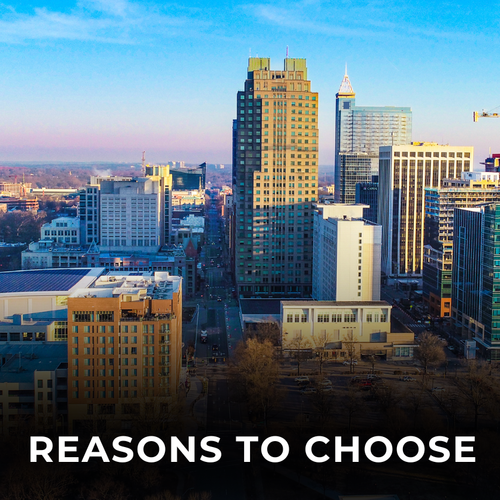


Raleigh has more than $6 billion in major developments planned or underway, and most homeowners have no clear way to tell which of those projects will actually matter to their property’s value.
Large-scale development rarely affects housing prices all at once. It changes demand patterns gradually, often years before construction is completed.
Understanding where jobs, healthcare, and major destinations are concentrating can offer early insight into which neighborhoods may experience long-term pressure on home values.
How Large Developments Typically Influence a City
Projects measured in the billions rarely change a market overnight.
Their impact usually unfolds in phases:
- Planning and announcement, when attention increases but pricing often does not
- Infrastructure and early construction, when demand begins to concentrate
- Operational maturity, when jobs, visitors, and daily activity reshape surrounding areas
Understanding where a project sits in that cycle often matters more than the headline itself.
If this kind of breakdown is helpful, we share similar market intelligence and local insights regularly on YouTube. You can subscribe to stay updated as Raleigh continues to evolve.
Downtown South: A Vision Still in Flux
Downtown South was introduced as a $2.2 billion mixed-use district planned for roughly 140 acres just south of downtown Raleigh, near South Saunders Street and Interstate 40.
The original proposal included a 20,000-seat soccer stadium, residential towers, office space, hotels, entertainment venues, and large areas of green space—effectively reimagining Raleigh’s southern gateway.
The stadium element became the focal point and, ultimately, the complication. Raleigh was not awarded an MLS franchise, and shifting financing conditions pushed the project into a holding phase. While some residential and office planning has progressed, the full vision remains uncertain.
That uncertainty is precisely why Downtown South remains relevant. Large land assemblages and experienced developers often re-enter the picture when conditions change. If that happens, nearby neighborhoods—particularly Boylan Heights, Mordecai, and parts of Southeast Raleigh—could experience long-term ripple effects.
This is not a story of immediate change, but of latent potential.
North Hills Innovation District: Jobs at the Center of the City
The North Hills Innovation District represents a different kind of momentum.
Covering approximately 33 acres within North Hills, the project is designed to bring technology, life science, and research-driven employers directly into an established urban district. The first phase includes Tower 5, a 17-story office building with more than 320,000 square feet intended to attract major employers.
Job-centered development tends to influence housing demand in predictable ways. When companies move in, employees follow. Over time, nearby neighborhoods often experience sustained pressure on inventory and pricing.
Beyond office space, the district also includes residential units, retail and restaurant space, and public gathering areas—reflecting a broader shift toward walkable, mixed-use environments.
Patterns like this have appeared repeatedly across the region. Additional examples and analysis can be found throughout the Triangle Market Intelligence series.
A Regional Healthcare Project Reshaping the Suburbs
One of the most consequential developments discussed here is not located downtown.
UNC Health and Duke Health are partnering on a children’s healthcare campus in Apex, located within a new master-planned community near the intersection of US-1 and NC-540. Estimated at $2–3 billion, the project includes a children-only hospital, outpatient care facilities, and a dedicated mental and behavioral health center.
Large healthcare campuses tend to reshape surrounding areas over long timelines. They draw specialized professionals, support services, and families seeking proximity to care. Over time, that demand often spreads across nearby towns and suburbs.
Communities such as Apex, Holly Springs, Fuquay-Varina, and parts of Cary are likely to feel those effects gradually as the campus takes shape. Long-range institutional projects like this have been examined in other Triangle Market Intelligence reports across the Triangle.
Brier Creek’s Sports Complex and the Impact of Visitors
While some projects unfold slowly, others introduce immediate activity.
The Brier Creek Racquet and Paddle Sports Complex, a $125 million development covering roughly 44 acres, is designed as a destination. Plans include more than 80 courts across multiple sports, along with dining, retail, and training facilities.
Once operational, the complex is projected to draw over a million visitors annually. Visitor-driven development tends to affect communities differently than employment centers, bringing increased demand for services, short-term traffic, and stronger support for restaurants and hospitality.
Handled well, projects like this can strengthen a neighborhood’s identity and economic base. Either way, the presence of a destination of this scale changes how an area functions.
What These Projects Have in Common
Individually, each project tells a different story. Together, they reveal a broader pattern.
Raleigh’s growth is no longer concentrated in a single corridor or driven by one industry. Instead, it is being shaped by employment hubs, healthcare infrastructure, and destination-level amenities spread across both urban and suburban areas.
Developments like these don’t just add buildings. They influence where people choose to live, where businesses follow demand, and how neighborhoods evolve over time. That influence often becomes clear only after the cranes arrive—and sometimes well after they leave.
For continued perspective on how these forces are shaping the Triangle region, explore additional analysis in the Triangle Market Intelligence category.
Looking Ahead
Raleigh’s development pipeline reflects a city in transition, balancing long-term planning with immediate growth pressures. Some projects will evolve. Others may pause or change form. That is normal in cities growing at this scale.
What matters is understanding how these forces typically play out—not trying to time every headline. For homeowners in particular, that understanding often becomes most valuable well before visible change arrives.
Check out this article next